

Do I have good clavicles?
Plus “You met me at a very Chinese time of my life,” spoilt VICs and how to engage with fashion when the world has gone to shit.

This week’s upload moves through memeified sino-fascination, looksmaxxing as a symptom of masculine collapse, the ethics of caring about fashion while society implodes into despair and the luxury industry’s dependence on a tiny, volatile elite.
But if you’re going to read just one thing this week, let it be this:

The cultural norms, narratives and power structures that define what’s acceptable.
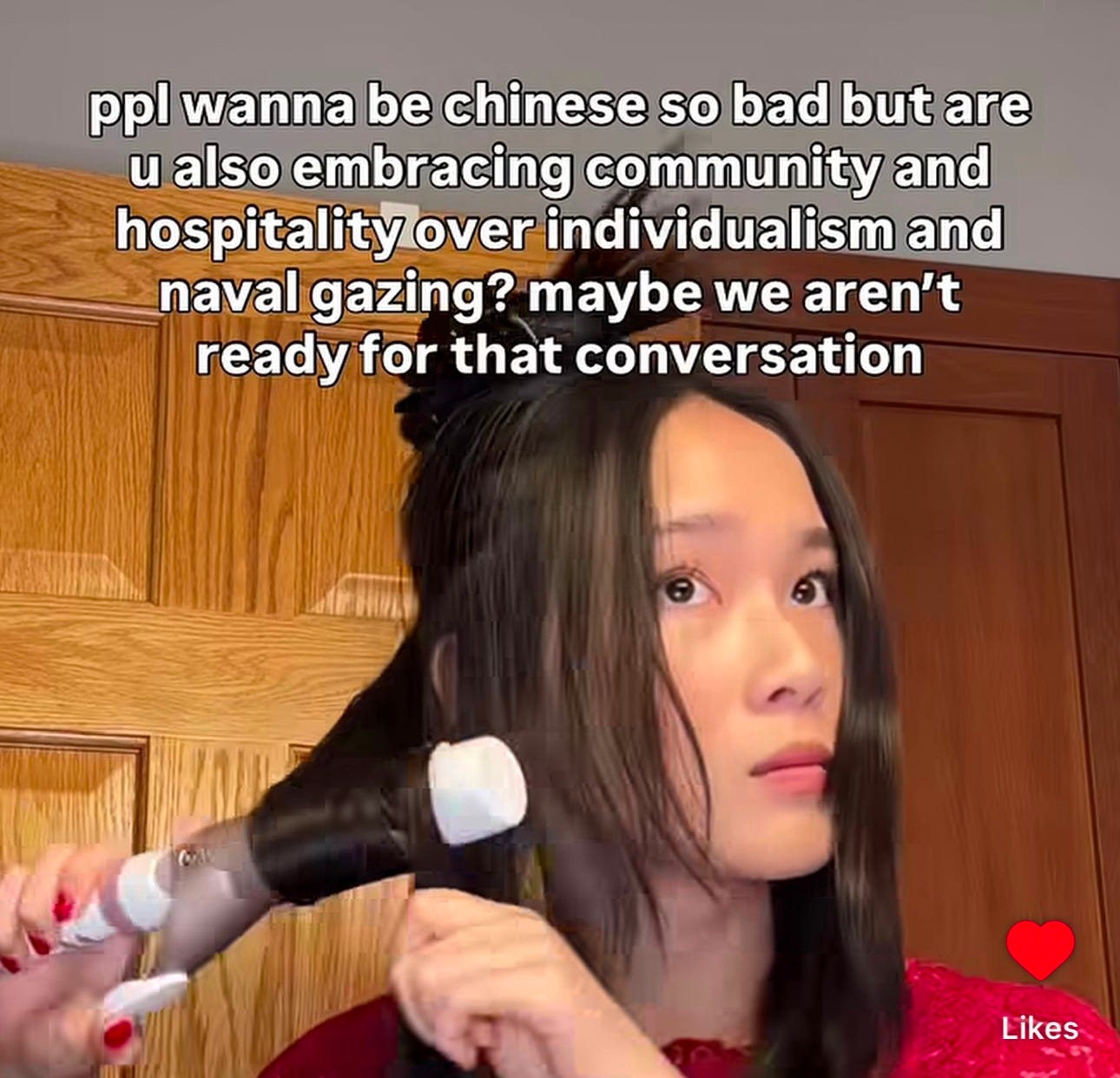
My Year of Rest and Chinese-maxxing
I haven’t been on TikTok in 2026, but I remember thinking during my last scroll: Wow, everyone seems really into traditional Chinese medicine. Ear seeding, cupping, not drinking cold water, mugwort, tongue diagnostics - it all feels suddenly ubiquitous, a shift that Emily Sundberg also noted in her newsletter yesterday.
Part of the reason lies in something I explored in this piece about rhythmic health and traditional healing systems entering the mainstream:
“The increased demand [in ancient healing practices] is a direct response to burnout,” says Bradden. “Biohacking promised control, but it delivered exhaustion. Wellness tech told us to track everything, but tracking didn’t make us feel better, it just gave us more data to stress about.” After years of living against natural rhythms, whether through artificial light, constant stimulation or uninterrupted productivity, Bradden argues that many people are now “dysregulated at a cellular level”. Somatic and traditional practices, she says, resonate precisely because they restore what the modern world has stripped away.
But this also feels tied to a broader, slightly memeified fascination with being “more Chinese” right now, captured in phrases like “you met me at a very Chinese time in my life” or “you have to get more Chinese,” which have been circulating widely online. Minh Tran does a strong job of unpacking this fixation above, which I’d argue has its antecedents in the early panic around a potential TikTok ban, when users briefly migrated to Redbook, encountered Chinese users directly, and realised how much of their understanding of China had been shaped by adversarial, propaganda narratives. That moment cracked something open, but not very deeply. As Tran points out, the fascination stops well short of ideology or understanding. What emerges isn’t tankie politics so much as an aspirational Orientalism…less about China itself than about American decline…

‘Looksmaxxing’ Reveals the Depth of the Crisis Facing Young Men
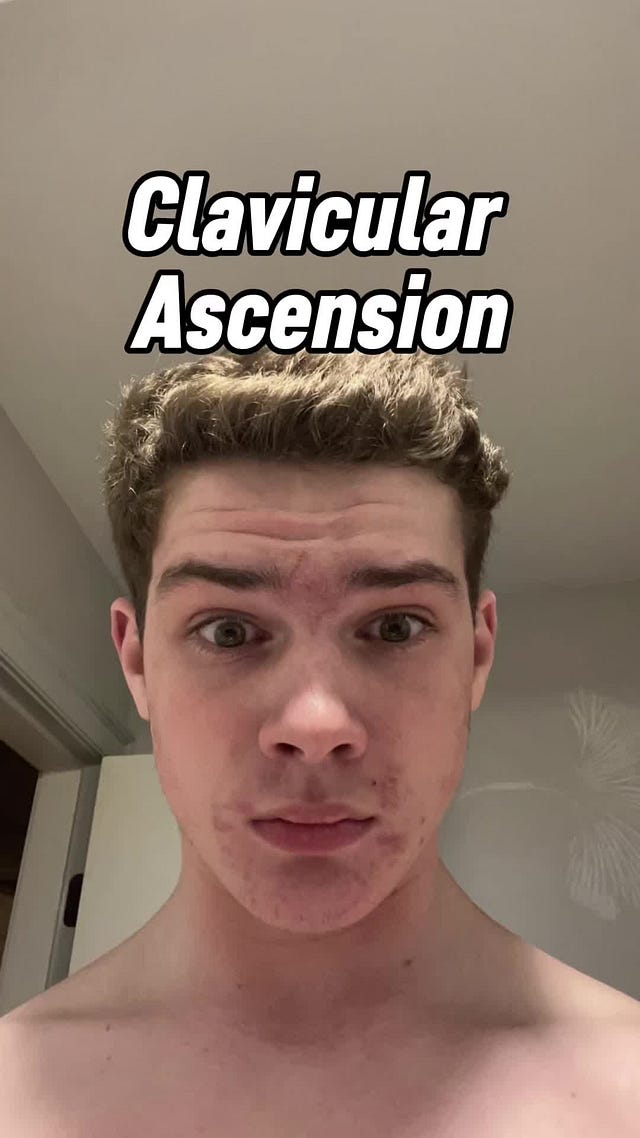
The looksmaxxing subculture feels like a grotesque end-stage of our contemporary beauty culture. Spearheaded by Braden Peters, aka “Clavicular” - a nickname referring to the unusual importance looksmaxxers place on the width of their clavicles (aka collarbones) - “they trade stories of breaking their legs in order to gain extra inches, ‘bonesmashing’ their faces with hammers to heighten their cheekbones, injecting steroids and testosterone to inflate their muscles, and even smoking crystal meth to suppress their appetite.” Grim.
 Tiktok failed to load.
Enable 3rd party cookies or use another browser
The worst part is that for many of these men, beauty is no longer a means to anything else. “For many members of the group, though, looking good is not a path to social or romantic goals; it is an end in its own right, a kind of self-glorification,” writes Thomas Chatterton Williams. Their aspirational figure isn’t the charming womaniser but Achilles, aka, excellence defined by domination over other men. What’s missing is any shared purpose beyond hierarchy, which makes sense. In the absence of stable work, social authority or coherent ideals, masculinity collapses inward, competing wherever it can.
As economic insecurity deepens and the pathways that once promised mobility feel increasingly hollow, it’s not surprising that faith in institutions gives way to faith in the body. If nothing else can be reliably changed, at least the self can be optimised. Looksmaxxing may remain an extreme expression of this impulse, but the logic behind it (relentless self-improvement without any larger social payoff) already feels familiar, and increasingly hard to contain.

What we wear and what it says about our values, identities and roles.
Lately, I’ve been struggling to share anything around my usual beat because it all feels so trivial against what’s happening in the world. It’s hard to talk about clothes or culture when ICE is shooting an unarmed nurse in the streets, taking five-year-olds with Spider-Man backpacks into custody or when Jared Kushner is casually announcing plans to build luxury resorts in Gaza. The dissonance is paralysing.

That’s why I found Mandy Lee’s video where she asked how you engage with fashion during moments of profound despair, hopelessness and grief so important. She argues that beauty, art and fashion can be small but necessary pockets of joy during times of despair. NOT as a retreat from activism, BUT as an act of resistance against the dehumanising effects of fascism. “Especially when I think about things that fascism wants to achieve, right? It is robbing and stripping anyone of their individuality with the way they think, the way they dress, the way they express themselves. I really do think that it’s a small, small act of rebellion against fascism to enjoy fashion and art and craftsmanship,” she says.
Cathy Horyn (my Queen) touches on something similar in her review of the menswear season above, noting how designers are responding - subtly or overtly - to “the chaos and cruelty in today’s world, a police-state culture.”
Still, in the grand scheme of things, finding it really hard to push through the perceived pointlessness of it all. More on that next week…

The logic of consumption, capitalism and commodified desire.
In my latest Vogue Business report, I looked at how very important clients are navigating the current wave of creative director changes. Bain estimates that VICs - just over 2% of customers - now account for 45% of global luxury spending, up from 35% in 2021. What happens when that 2% isn’t convinced?
I loved getting to speak directly with luxury training consultants and VICs themselves about the many, often wildly inventive ways brands persuade rich people to spend their money. From arranging private visits to Formula One paddocks to meet Lewis Hamilton, to flying clients to Cannes to walk the red carpet, the selling point is rarely the product alone.

The digital systems that shape how we interact, transact and behave.
How to start your job in fashion in the age of AI
I found this piece on starting a career in fashion in the age of AI particularly interesting for what it reveals about young people and entry-level roles. As with most technological shifts, the impact lands hardest at the bottom first. What schools and brands seem to agree on is that, as information becomes faster and easier to access, the real skill lies in knowing how to ask good questions, experiment with the tools, and critically evaluate what comes back. As one industry expert puts it:
“First and foremost, it’s about originality and cultural capital. Brands employ people for the knowledge that they bring,” says Thompson. “So yes, you can write something quickly, but what’s your awareness of what’s going on? What groups are you tapped into? What information can you bring? This understanding of your brand’s customer and the landscape of what’s happening at the moment is as important as an understanding of your team.”

Thank you for highlighting an Asian creator! Can you link her video that you mentioned?
On the money as always