Extended cut: Tony Wang
More thoughts from the man who said: "Taste is when a brand resists market dynamics"

I need to start a podcast.
Through my work at Vogue Business, I spend a big chunk of my week in long conversations with people who are absolute experts in their fields - individuals who have built their knowledge through years of actually Doing The Thing™, but don’t have time (or inclination) to turn it into content online. The amount of mind-expanding wisdom currently trapped inside my voice notes app is irresponsible. Please hold me accountable if I haven’t launched it by September.
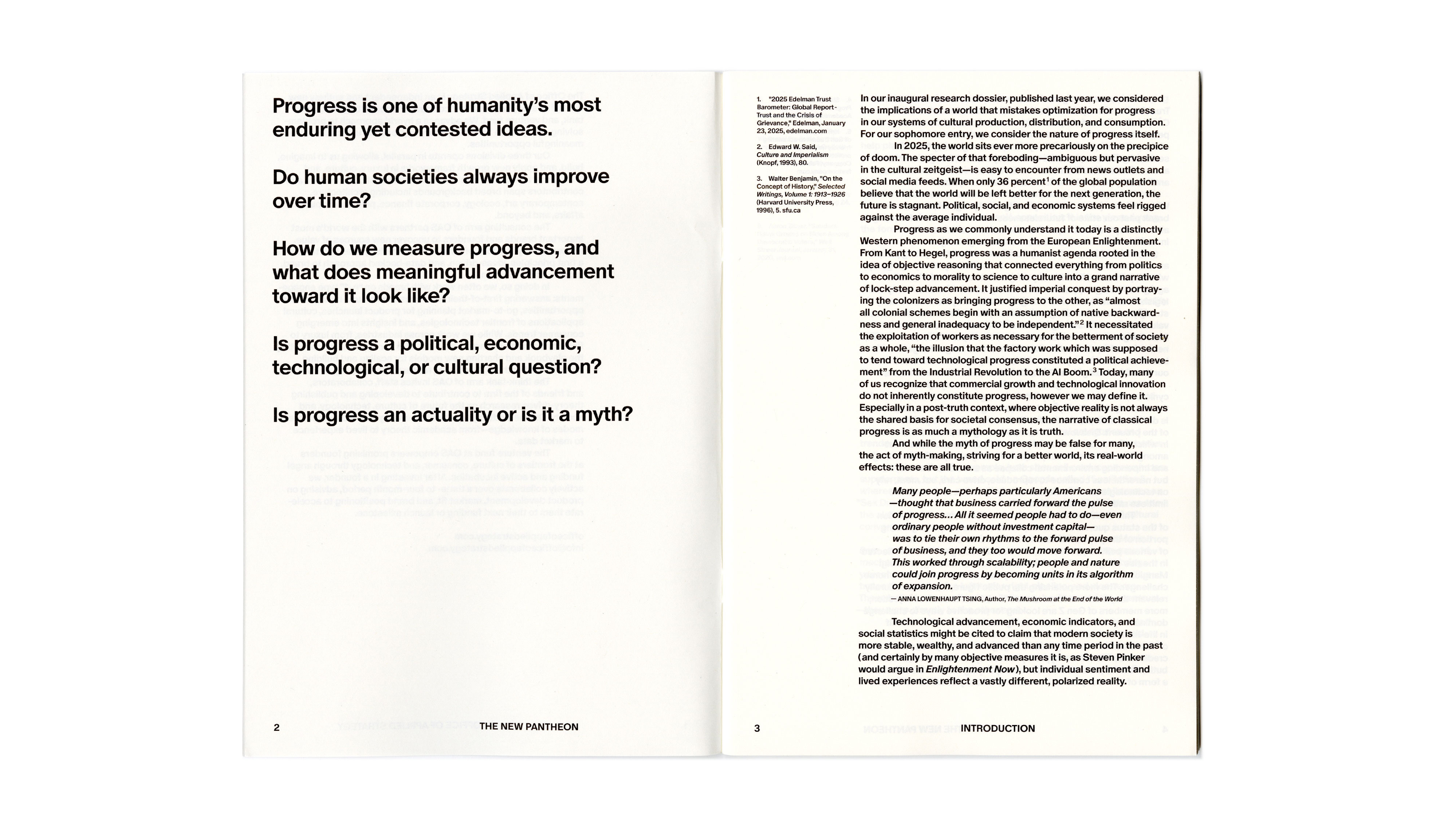
When I do, Tony Wang will be high on the guest list. He’s the founder of Office of Applied Strategy, a hybrid of consulting firm, think tank and venture fund. I first came across OAS via their second dossier about Horseshoe Maximalism, a term they coined to explain how “political polarisation today has given way to new cultural trends that embrace contradiction and extremities”. I won’t say any more - these physical-only annual research publications are deliberately limited to just 1,000 copies - but if you ask nicely here, then they might send you one. If not, better luck next time.
His insights formed the backbone of my latest piece about taste in the age of AI. I’ve complained about before, but it’s criminal that I only get 1500 words to cover something I’ve spent days researching and reporting. So in the meantime (while I sort out a few technicalities for the podcast) he kindly allowed me to share an extended cut of our conversation here.
Read on for thoughts about why taste isn’t a problem for tech to solve and whether venture capital is the sexiest form of finance.
To start broadly in a brand context, specifically fashion and beauty, what is taste and how do you apply it? It’s such a nebulous concept and hard to define. How do you take something so intangible and apply it to brand-building? And how do you think that’s changed over the last five years versus now, in the age of AI?
I won’t wax too poetic on the metaphysics of taste - that’s such a huge debate. And I think when tech bros talk about taste, they mean it in a much narrower aperture compared to how it’s discussed more broadly. But in the scope of what we’re discussing, the easiest definition I’ve heard - and one I agree with - is that taste is conviction.
I don’t know if “democratises” is the right word, but AI has rendered a lot of knowledge economy-based industries potentially replaceable, or at least made the cost of accessing that knowledge close to zero. Because now AI can index and pull from almost all publicly available data and present that information to you. So, in terms of taste, there’s a layer that is the knowledge base and the references, but that aspect of taste is being compressed toward zero.
A key aspect of taste is not simply knowing all the designers or all the options. It’s the curation and deployment of that knowledge, whether that’s in styling yourself, making a decision, or expressing your own taste level. It’s also a conviction in certain approaches and certain ideas. That is what leads to the expression of taste, and that conviction layer is interesting because that’s the thing AI is unable to do. AI can tell you all of these things, but it still cannot make the decision. And when it does make decisions, it is essentially a regression to the mean. AI, as we’ve built it today, is entirely probabilistic.
There was a counterpoint made by Nan Yu from Linear who tweeted: “I hate to break this to everyone, but you probably don’t have better taste than the AI.” He argues that people are delusional for thinking AI can’t replace “taste”, and that we’re projecting our insecurities onto AI (though his specific example of taste is in relation to product decisions). I think he’s pointing to this idea of the emulation of taste, which I agree with. But a lot of taste is about practice and experimentation - that’s how you develop conviction. The reason someone is stylish is because they take the time to experiment and learn. That also brings in the class dimension, because access to taste often requires a certain level of material access in order to have that exposure. That’s why a lot of art collectors come from wealthy families - they grew up in environments where they had the time and exposure to appreciate art, let it gestate and develop a point of view.
But ultimately, that conviction layer is what AI can’t replace, because AI simply can’t have conviction. It can tell you probabilistically whether something is a good idea or not, but it can’t give you the conviction or confidence to say, “this is the thing I’m going to do.” And I think that’s the aspect of conviction that a lot of tech people are latching onto, because taste - at its core - is a function of human discernment and judgment applied in a way that creates distinction and differentiation.
Taste is also about difference, which is why it’s linked to luxury. It’s about exclusivity - it’s a different way of thinking. I joke, I think Anthropic is tasteful, and I think OpenAI is not tasteful. The reason I say that is that OpenAI might have values, they have a creative direction, and they have a brand - it’s consistent. But the reason I don’t think it’s tasteful is because everything it does feels like the most optimised, calculated business decision to maximise value. Everything is driven by optimisation. So there’s no real expression of conviction about what it believes in. Simply following market dynamics is not an expression of taste, because that is just doing what the market would do.
Whereas Anthropic feels like it makes decisions that resist market dynamics. That’s another way I frame it to tech and VC audiences: taste is, in a brand sense, the ability to resist market dynamics. When companies do things that resist the profit incentive - even if they may generate money in the long run - that’s a tasteful brand. For example, A24 is very director-friendly, very invested in storytelling and brand building. In the short term, it might not look optimised for revenue or commercial gain, but in the long term it creates value differently from a generic commercial entity.
What I’m seeing a lot of - whether it’s through generative AI chatbots or vibe coding - is people who historically wouldn’t have had the money or skills to do something are now able to. At the same time, the people who used to build brands and clothing companies were often driven by something beyond money. If it was purely financial, they would have done something easier.
But with AI, a lot of what I’m hearing is this idea that if you don’t jump in now, you’re going to end up in a permanent AI underclass, and that this is a once-in-a-generation opportunity to make money. There’s a lot of that thinking emerging because, historically, it just wouldn’t have been possible for one person to build certain things without serious investment. Now there is an ability to saturate the space in a very different way.
All of that to say, I think we’re at a precipice where there will be an interesting taste gap, because there will still be people who build things with conviction and values, but at the same time, there will people responding to a perceived opportunity and momentum of a “gold rush”.
If we bring this back to fashion, I think that when we look at the recent creative lull in luxury fashion, a lot people were saying saying, “I just feel like you’re trying to make money off us, and we’re not idiots. We can see through it.” And now we’re seeing a focus towards creativity again. With that in mind, when you work with brands, especially thinking about conviction and value judgment, how are you giving them parameters to discover that?
There are three things I think are worth bringing into this. The first is that a huge part of the OAS philosophy is that we say internally and to clients that OAS is a constant investigation of what value really means. A big part of that comes from a personal question around value, and a desire to move beyond traditional capitalist constructions of value as pure scale or incrementality. So a large part of our work is finding new pockets of value. We help companies uncover and tap into new sources of value. A lot of what we do is help companies reframe the question of what they actually care about - what value is, and how to move beyond traditional KPIs and conventional ways of thinking about growth, in order to build new systems of value creation.
Second, this connects to a broader trend where everyone wants to be a cultural protagonist. This blew up around 2020, when every company suddenly wanted to be an entertainment brand and be relevant in culture - even if, for example, a defence tech company like Palantir. They want to be relevant culturally, so they engage in cultural marketing. And that shift was actually very helpful for OAS, because it put brands in a position where they realised that in order to grow and generate value, they needed to show up in culture in a meaningful way. That already forced a different kind of thinking, because it’s a very different approach to marketing and brand-building, so we were in a position where we could help brands rethink what value actually means.
Finally, I’ll link it to the third point, which relates to what you said about AI allowing us to do anything. The real question becomes: what do we want to do? And I think that’s really important, because we talk about this on a personal level too - how AI allows everyone, including college students and potential entrepreneurs, to essentially have the world at their fingertips - you can build any app you want, everything is possible. So now it’s up to you to decide what you want to do, and that comes back to conviction.
The same question you pointed to at an individual level - what do we want to do with our time? - also applies to brands. Philosophically, that connects to existentialism - think Kierkegaard or Sartre - the idea that you can do anything, your life can mean anything, but that freedom is also terrifying. It’s the same with AI. To a degree, it allows us to do almost anything, and increasingly it will remove technical and time constraints by doing a lot of work on our behalf. But brands are also now dealing with that same fundamental question.
Another major paradigm shift that people don’t talk about enough is that AI has also been a reckoning for brand media, because now anyone can copy your paid media playbook. Anyone can copy the way you show up in the world through brand, marketing, and all the touch points that are effectively a layer of taste. If AI can do all of that better than you, then the question becomes: why do you actually exist? Brands are realising they need to develop a stronger sense of differentiation. It used to be easier to stand out pre-AI, but now there are much stronger competitive forces both internally and externally.
That’s kind of why so many tech people and VC people are latching on to taste, because it’s also, I think, a self-indictment of themselves. VC is ostensibly about deploying capital as a function of knowing the future. That’s what makes it, to me, the sexiest form of finance. Compared to private equity or other forms - distressed assets, hedge funds, commodities trading - those are based on existing businesses or known histories. You’re taking something with a track record, maybe fixing it, and selling it again.
Venture capital, on the other hand, is future-facing and highly asymmetric. It’s about investing in something unproven that doesn’t exist yet, and deciding whether it will make money in the future without precedent. That’s why every VC fund presents itself as thought leaders, focused on foresight and forecasting, even though a lot of their forecasting is not particularly salient. But they have to position themselves as oracles or seers in the financial world, because they are deploying capital based on that future orientation.
At the same time, if you’ve ever worked with or spoken to people in VC, the industry is gripped by constant FOMO and comparison. It’s very much a case of, “If this fund is investing, we need to invest as well.” For a group of people who talk a lot about taste as conviction, I’ve rarely encountered an industry with so many people who actually lack a strong sense of conviction. If you speak to founders, a very common experience is that when they meet VCs, no one is immediately ready to write a check. Everyone says, “We’re interested, let’s stay in touch,” but they want to maintain optionality and wait for someone else to move first. A typical scenario is that fundraising takes three to five months. For the first two and a half months, VCs say things like, “We love your idea, let’s stay in touch,” but no one commits. Then once one person writes the first check, everyone suddenly follows, and the round closes in one or two weeks.
It’s also a broader self-indictment and realisation that AI reveals the gap between what VC promises - being arbiters of taste and knowing where the future is going - and the fact that the industry often operates in a way where there is very little exercising of conviction, and instead a constant demand for perfect optionality. Which is something a lot of VC people talk about. When I ask them how quickly they form conviction around who they invest in, they often bring up this idea of optionality. And I’m just like, “That’s basically your way of saying you’re swiping right on a bunch of people you find attractive and then not wanting to commit to who you actually want to date. You want all the options, but you don’t actually want to take that step.”
I want to go back to the split you mentioned in taste - between references on one side, and conviction on the other. If AI is doing that first half very well, and we’re moving into a place over the next three to five years where brands will need to show more conviction, how do you see that dynamic manifesting? Specifically, how might this show up in marketing campaigns or in the way brands operate?
A lot of people are focusing primarily on the aesthetic component of taste, which is one aspect of it. But I think it’s going to show up much more in how brands, beyond marketing, build products and think about experience. It’s really about how you differentiate on a fundamental level.
It’s similar to how artists might create visually similar works, but their process and practice are fundamentally different, which is what makes them distinct and not really comparable. It’s the same with brands, where the ones that develop strong operating systems and ways of thinking - systems that encode their brand philosophy and how they see the world - are the ones that are able to exercise conviction and taste more deliberately. Again, that’s kind of the difference between OpenAI and Anthropic. OpenAI potentially might get banned by the DOJ, whereas Anthropic shuts down Sora. It’s the difference between the actions of two different AI companies and how taste is expressed through those decisions.
In terms of marketing, I do think brands that have a real point of view will perform better, because anything that is more functional content - lookbook imagery, product imagery, PDP imagery - AI can already emulate and do so effectively. Over time, that likely won’t be the point of differentiation. In a world where a lot of the more fundamental transactional, utility-driven aspects of a brand can be replicated perfectly by AI, brands should be using AI to streamline those areas so they can focus on everything else. In the same way, AI in general should be deployed to handle busy work and more utility-driven tasks, so that it frees us up to focus on bigger-picture thinking - building conviction and working through the higher-level questions.
As a side tangent, I often tell founders not to use AI to solve for taste. I think this is something a lot of people misunderstand. Some startups use AI in a way that helps them focus more on developing taste, while others try to use AI to actually solve for taste itself. For example, that’s where Suno, the AI music generation company, got into a lot of trouble. The founder said he built it to solve the problem of music production, and a lot of musicians pushed back on that idea, questioning whether music is even a “problem” to solve in the first place.
It reveals a very typical tech-founder mindset, where a lot of people in tech and VC are primarily focused on building things that generate value or make money, and in that process they look for “problems” to solve that may not actually be problems. In the pursuit of finding value at all costs, they often end up trying to solve things that aren’t really problems at all. Startups that try to “solve for taste” are not taking the right approach. That’s not the right problem to solve, because taste is something we should be defending and empowering - giving humans more time, bandwidth and space to focus on and cultivate.
There’s an aspect of taste where AI can emulate it, and that’s totally fine and that will always exist. But “solving for taste” isn’t the right framing, because taste, by definition, starts to touch on things that make us distinctly human: conviction, what we believe in, what we hold true. Good taste is developed through friction. To have good taste means you have to experiment. You have to, at some point, wear something and think, “Oh, this really doesn’t work,” or take a risk and have it not pay off. That’s how taste is formed. It’s a process, it’s a practice. So if AI streamlines everything and removes, or de-risks, the friction involved in developing taste - which is a constant state of experimentation, practice, and emulation - then it starts to feel like that’s not a problem worth solving, because it removes the very aspects of taste that make it meaningful and worthwhile.