

Fundamentals are the building blocks of fun
To think and write beyond the algorithm's reflexes you need a foundation deeper than the feed.

I am a very sleep girl at the moment. If there were a trial clinic for symptoms of chronically drowsy with a side of existential languishing I would qualify for the long-term study. I owe so many people texts that I’ve moved iMessage off my iPhone dock because the escalating red numbers were giving me heart palpitations. I feel guilty but only in the counterproductive way where my guilt compounds into even more avoidance, particularly around self-invented Substack deadlines I assign myself.
Last Friday I finally caved in and took the day off to watch my favourite comfort films. By the time I put Uptown Girls on I was deep into my rot, but when Dakota Fanning’s character, Ray, proclaimed that: “Fundamentals are the building blocks of fun” (a quote originally by ballet dancer Mikhail Baryshnikov), it somehow cut through the brain fog.
I’ve been thinking about this a lot in relation to good thinking and good writing. In a recent AMA, a few people asked for writing advice (I promise I’ll get into the specifics next week), but for now here’s the only thing that actually matters: expand your media diet. Read the writers who inspired the writers you love now. Follow the lineage backwards. Everyone always says that reading makes you a better writer, which is true, but more importantly it makes you a better thinker.
Part of the reason the never-ending online discourse is so insufferable is that we’re all just reacting to each other in real time, like a giant communal flinch. We’re responding to responses to responses, and by the tenth reply-chain we’ve completely forgotten what the original thought even was. Identity, desire, technology, politics, spectacle, gender, power, the body, the internet, the self - the things we scream about online as if they were born yesterday - have been dissected, flayed open, theorised, critiqued, mourned and reimagined by writers who were paying attention long before we even had usernames. The greats have already mapped so much of this terrain, and this is why reading them matters. They give you the fundamentals that make the whole circus legible. Once you have those foundations, you stop reacting to whatever someone posted five minutes ago and start noticing how we got here, which parts are genuinely new, which parts are just old patterns dressed in new costumes and which differences actually matter. And then - then - your job becomes interpreting the new strangenesses of now with the inheritance of the thinkers who came before you.
Here’s where I’d recommend you start…

Toni Morrison - “The Site of Memory” (1987)
In “The Site of Memory”, Toni Morrison confronts the profound silences in the historical record, especially around the lives and interior worlds of Black people. She argues that writers must look beyond what was documented and turn toward the deeper truths that were deliberately omitted or unable to be expressed. For Morrison, memory becomes a repository of emotion, experience and humanity that official history often refuses to hold. An immensely important view when thinking about how today’s algorithms erase or distort what doesn’t fit neatly into their profit logic or political agenda.
Donna Haraway - “A Cyborg Manifesto” (1985)
Donna Haraway’s A Cyborg Manifesto is one of those essays that makes you feel like your brain just got plugged into a power outlet in a good way. She hands you the cyborg as a metaphor for life in a world where boundaries between human, machine, gender, technology, identity are blending into this messy but liberating hybrid space. Would love to read someone incorporating these ideas into the age of deep fakes and artificial intelligence…
Susan Sontag - “The double standard of aging” (1972)
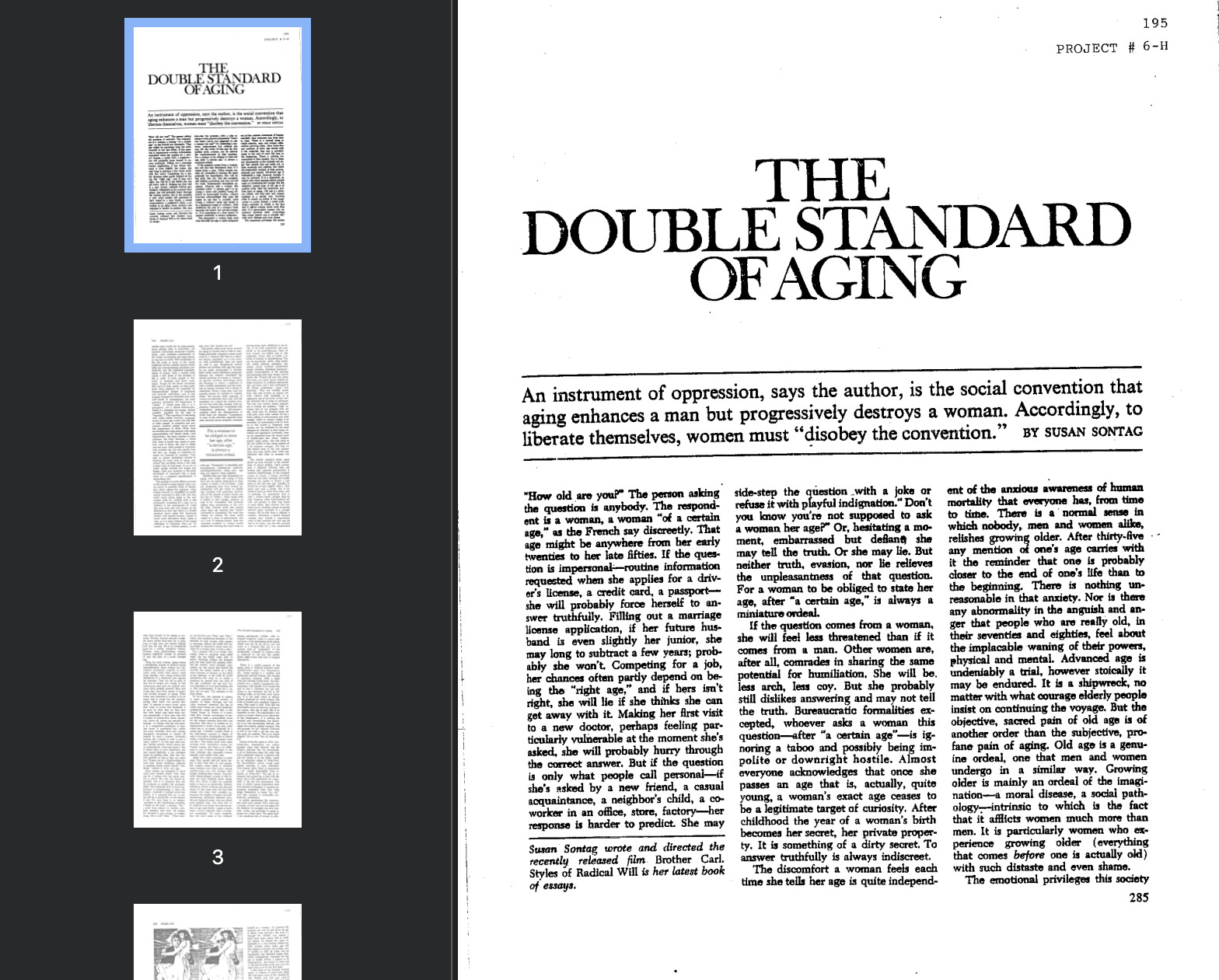
Reading this feels like walking through a hall of mirrors where only women’s reflections have been distorted. Sontag lays out how aging becomes a spectacle when it’s happening to women, while men float into later life wrapped in automatic prestige. RIP Susan Sontag you would have hated Facetune and skincare for children.
Mark Fisher - “Existing the Vampire Castle” (2013)
Fisher takes on guilt politics, online moralism and the suffocating dynamics of call-out culture (bare in mind Instagram was only three years old at the time). Read it to see what I mean about learning the fundamentals.
Sherry Turkle - Always-on, Always-on-you: The tethered self (2008)
Turkle examines what happens when the phone stops being an object and becomes a condition. The essay maps the shift from “using technology” to living inside a constant digital tether. I want to read someone expand upon these in the era of smart glasses, which seem committed to keeping our eyes even more locked onto screens.