The case against snark
+ are affiliate links the new brand deal? Has hype given way to lore? Would HS Tikky Tokky do well on Love Island? Is vibe coding about to be the new man in finance? This & more...

I haven’t done one of these for a while because I saw a video where Charli XCX said “In and Out lists” were out and I got a bit self conscious, lol. But then I remembered that loads of publications posted that Brat Summer was dead and she came back with a whole second remix album and a film. So in that spirit, here are some long-overdue outs and ins…
Disclaimer: this isn’t (for the most part) a taste-based in/out list. It’s a read on changing consumer behaviour, retail dynamics and marketing trends - what’s gaining ground, and what’s falling away. I do not condone all of these developments.

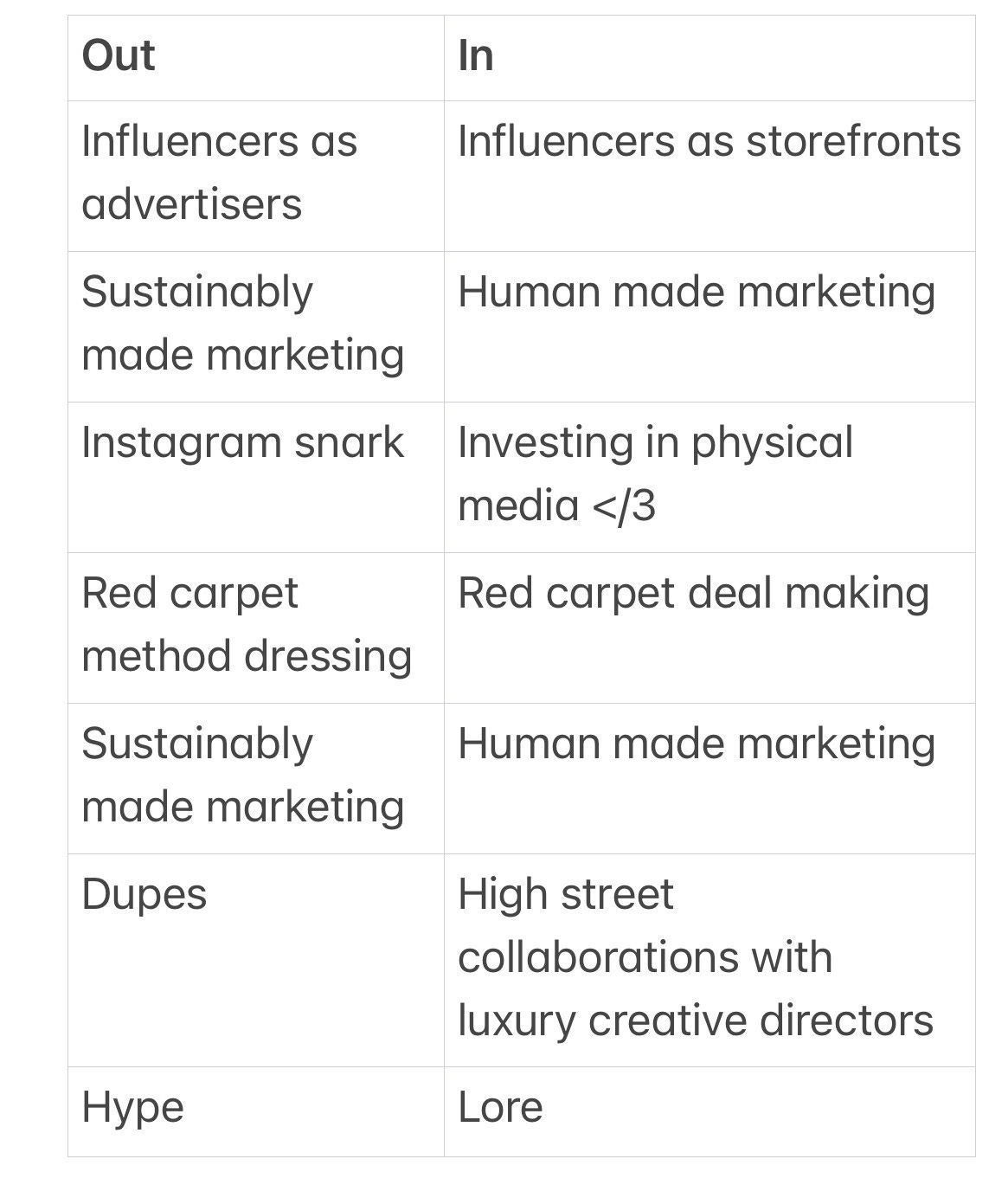
OUT: Influencers as advertisers; IN: Influencers as storefronts
Is it just me or does it feel like everyone is suddenly making serious money off affiliate links? One creator I follow, Mia McGrath, said in February she made £27,337 off of affiliates alone. Another friend who runs a popular shopping Substack says she easily makes high four figures a month.
Part of it is that the whole affiliate setup feels more legit than it used to. Platforms like ShopMy and Conde Nast’s new storefront Vette are making it really easy to plug everything in one place and actually see what’s working. At the same time, every influencer I’ve spoken to recently has said that brand deals are not what they used to be. Budgets feel tighter, campaigns are smaller, there’s more back-and-forth, deliverables are creeping up, timelines are shorter… it just isn’t as easy or as lucrative as was a few years ago, which, given the state of the world, isn’t surprising.
Perhaps that’s why people are naturally shifting toward income streams they have more control over, and in the process, we’re seeing creators shift from being advertisers to retailers. Ironic, given how rocky things have been for a lot of e-retailers over the past few years. Still, it ties into one of my predictions that Amazon Fashion is going to be huge in the next few years - especially as more people care less about curation or “vibes,” and just want their clothes as fast and as cheaply as possible.
OUT: Sustainably made marketing; IN: Human made marketing
My latest Vogue Business piece is a big anti-AI slop marketing playbook, and one thing that really stood out to me is how hard brands are now trying to prove they’re not using AI, at least in their marketing assets. Fitting, as I saw someone recently say that this whole anti-ai slop positioning is going to replace sustainability as the marketing narrative. Craft as a marketing currency has already been building for a while, and it feels like “made by a human” is becoming the latest shorthand for “we’re a good, thoughtful brand” in the same way sustainability used to be - just with more focus on process, not just principles.
However it’s not like AI use is this clean, binary thing where you’re either “pure” or “cheating”. It’s already baked into loads of processes in ways we don’t even really question. Even for me, way before LLMs became this massive cultural thing, I was using Otter.ai to transcribe interviews. That is AI, but it doesn’t feel controversial at all.
So where exactly is the line? Is it more pronounced in marketing campaigns, where the goal is to sell aspiration? Or does it come down to how many creatives are displaced in the process? Or is it simply about what people have become used to? I’m really curious to see how this shifts over the next few years - whether human-made holds its value, or if it ends up mattering less as AI just becomes part of the baseline. WGSN is predicting that by 2028 no one will really care anymore, which feels bold but also kind of plausible. One to watch for sure.
OUT: Instagram snark; IN: Investing in physical media
RIP The Face magazine </3
Snark on Instagram has become so unbearable to me. It’s so easy to throw text on a screen and be dismissive, whereas formats that demand more effort tend to push you toward what you actually care about.
Having worked on three issues of Basement Magazine, it’s some of the most labour-intensive work I’ve ever done. The amount that goes into it is kind of insane: coming up with ideas, commissioning, organising shoots, troubleshooting the million things that go wrong, proofreading things over and over, refining design, making sure the order feels coherent. There’s no way you’d put that much time into something just to complain that something else is shit. Everything I worked on during that time came from a place of genuine love, because nothing else would carry me through that much effort.
As those kinds of outlets where you can invest that much time and care disappear, it makes sense that everything becomes more snarky. Instagram is full of it because it takes almost no effort. Bring make high-friction media creation!
OUT: Red carpet method dressing; IN: Red carpet deal making
Remember when all anyone could talk about was method dressing? Margot Robbie doing the full Barbie press tour cosplay, or Zendaya dressing in-theme for Spider-Man premieres? Thank God we’ve moved on a bit. Now it feels like people are finally talking more openly about the red carpet as what it actually is, which is basically a deal-making arena.
I read something recently that I loved about why we’re all so obsessed with the 90s, and part of it was this idea that back then, you didn’t have to think about the entire machine behind what someone was wearing. For example, someone could just show up to a premiere in jeans and it didn’t feel like a missed opportunity. The focus was on the film, not the fashion ecosystem orbiting it.
Now it’s kind of impossible not to see the machinery. Styling, ambassadorships, placements, even those supposedly “organic” appearances.. it’s all increasingly structured, and often part of much bigger commercial agreements, one that is not even hidden anymore. Multiple publications have recently begun talking about awards season in terms of deals. Maybe it’s just me, but I can see this very quickly turning off the average cinema go-er…
OUT: Dupes; IN: The high street collaborating with luxury creative directors
Or at the very least, it feels like the whole dupe conversation has really quietened down. There was a point where it was everywhere in constant discourse, people calling things out, side-by-sides, “run don’t walk” energy, DHgate like-for-like comparisons, and now it just doesn’t feel as loud.
Maybe this is a stretch, but I do think there’s something slightly funny happening. The cycle used to be runway → high street → Shein, and now a lot of the greats are just going straight to high street, whether it's John Galliano’s appointment to Zara, Zac Polsen at Gap, Clare Waight Keller at Uniqlo. Instead of filtering down through diluted versions, they’re bypassing that process entirely and going directly to the source, creating more accessible price points from the outset. It makes sense: the aspirational consumer is completely dead in luxury, so they have to approach them from a different angle or just lose them completely to dupe culture.
OUT: Hype; IN: Lore
I wrote something recently about how designers are increasingly tapping into their own personal history as a way to create meaning and build lore in a landscape where scale alone just isn’t cutting it anymore. You can see it in moments like Jacquemus casting his grandma as the brand’s first ambassador, or Jonathan Anderson inviting atelier artisan Paulette Boncoure, who began working at Dior in 1947, to attend his debut couture show. Even i-D doing a whole issue on lore feels telling. It points to the idea that what people are responding to now isn’t just aesthetics or volume, but the sense that there’s an ongoing story that builds over time, rather than appearing fully formed and then disappearing just as quickly.
You can’t have lore if you’re constantly info-dumping or churning things out at full speed. There has to be space for people to piece things together, which is why it feels like such an interesting counterpoint to generative AI, where the whole selling point is basically infinite output at once. It also sits in contrast to the hype era that defined the industry from around 2017 to 2024, from peak logomania to when the runway gimmick lost its impact. Instead what actually seems to be sticking now is that more layered kind of meaning that lore builds over time. Because then people aren’t just consuming, they’re following, and that holds attention for way longer.

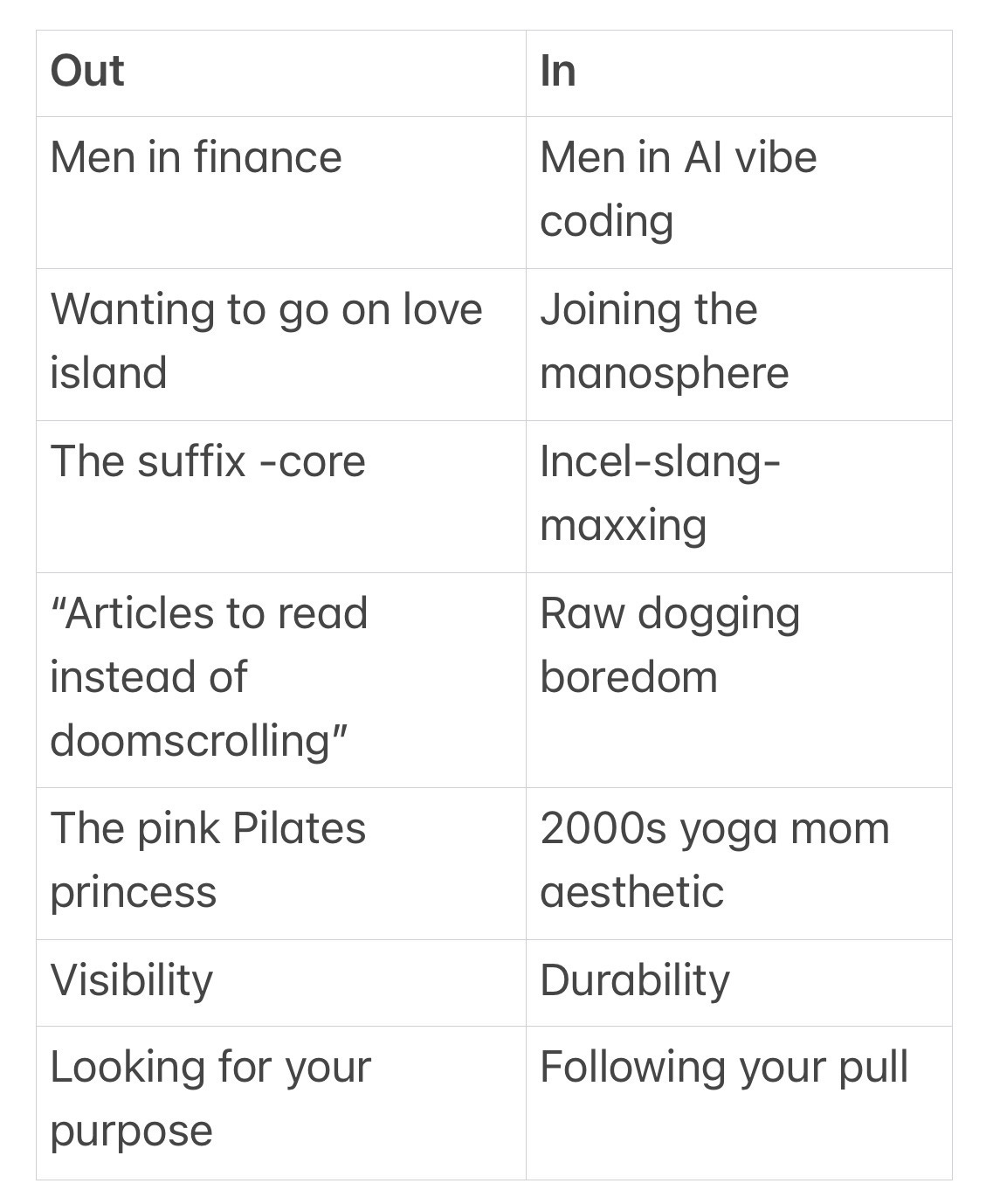
OUT: Men in finance; IN: Men in AI vibe coding
Chat, the girls are no longer looking for a man in finance. That Interview Magazine “Meet the finest boys in finance” story broke the illusion, or at least, the comments underneath the Instagram post indicated that we are collectively over them.

I keep content around vibe coding, aka people who use AI to prompt code that easily builds apps and websites, which feels like the next iteration of the archetype. The New York Times recently profiled Matt Gallagher, who reportedly built a company to a billion dollars in revenue using AI, pulling it together in just two months, with around $20,000 and a stack of AI tools. The startup, Medvi, is a telehealth company selling GLP-1 weight-loss drugs, and it’s projected to hit $1.8B in its first year. Gallagher and his brother are the only humans involved in the whole operation.
Over the past few weeks, my feed has been completely saturated with people evangelising AI vibe coding, framing it as this now-or-never opportunity, and that if you don’t get on board, you’re locking yourself into permanent underclass status. Meanwhile the “Claude gap” in relationships has replaced swag gap relationships as the cardinal sin. Girls, mark my words, this is about to dominate a lot of first date chat this summer…
OUT: Wanting to go on Love Island; IN: Joining the manosphere
I’ve been watching more HS Tikky Tokky and I genuinely think he would have done so well on Love Island if he’d been on during that Kem and Chris era. In a weird way, the pipelines aren’t that different. Love Island is framed as being about finding a partner, but underneath it is this very public performance of validation. Looksmaxxing spaces claim they’re not really about relationships (as Clavicular often says), but they still revolve around the same idea: the kind of validation that comes from who you could attract. It’s not the same thing, but it definitely rhymes.
More broadly, Love Island acts as a mirror for how people understand desirability, status, attractiveness, social capital, gender dynamics, popularity, etc. What’s interesting now is that those conversations have splintered and migrated into more niche, stranger online spaces. Here the manosphere has started to resemble a kind of get-rich-quick ecosystem, offering the same pulls of visibility and money, especially for disenfranchised young men. While it’s blown up in the US, in the UK it doesn’t feel as culturally dominant as it once did, and I think a lot of the people who might’ve gone on Love Island five years ago are now gravitating toward the manosphere instead. Bleak.
OUT: The suffix -core; IN: Incel-slang-maxxing
RIP -core. Cause of death: Maxxing.
OUT: “Articles to read instead of doomscrolling”; IN: Rawdogging boredom
I was fully guilty of this so absolutely no shade to anyone still doing it, but I do think that the whole content format is completely done now. You can feel when something tips from “everywhere” to “okay we get it,” and we’re firmly there. Of course, evil doesn’t die, it just reinvents itself. The newer version of this I’m seeing is all this “rawdogging boredom” or “nothing maxxing content.
There are only so many times you can watch someone explain that we’re all online too much… online. Best case scenario is that we end up consuming less content about consuming less content. But right now it feels like we’re stuck in this weird loop where people are still packaging the idea of “logging off” into something you can watch, like, engage with, share, etc, which is pretty ponzi-scheme-y. It feels icky to me that the value comes from naming the problem, only to turn it into more content that sustains the very system it’s critiquing. I just hope the next real shift isn’t another aesthetic or format, but actually posting less.
OUT: The pink pilates princess; IN: 2000s yoga mom aesthetic
Did you know that the Pink Pilates Princess wasn’t just a fun TikTok lifestyle aesthetic but actually a key consumer group, according to Spotify?
Well, maybe not for long. What I keep noticing instead is this shift toward something the “2000s yoga mom aesthetic”. Less $100 polyester Alo leggings and more intuitive, manifest energy wrapped in natural fibre baggy workout gear. Very The Secret, very Addison Rae in her current era.
OUT: Visibility; IN: Durability
We’ve now been through so many boom-and-bust cycles with influencers and platforms. Vine, Tumblr, early Instagram, TikTok waves, Substack spikes… there’s always this moment where something feels like the place to be, and then almost as quickly, it just loses energy. If your whole thing is built on visibility within one of those ecosystems, it’s kind of fragile by default.
The focus is moving toward durability. Not just being known, but being able to last. Having something that holds even when the algorithm changes or the platform cools off or the audience moves somewhere else. That’s where having a really defined, almost stubbornly clear base comes in. Not even necessarily a “brand” in the polished sense, but more like a point of view that people actually recognise and come back for. Something that doesn’t fully depend on where it’s being distributed.
OUT: Looking for your purpose; IN: Following your pull
Maybe my next -coded should be about cultivating intuition…