

Do I have your attention?
Okay, so someone watched your video till the end… but how long will they actually remember what you said?


Two years ago, I spent eight months on a book proposal that didn’t sell, in part, because I didn’t have a large enough following on social media. Since then, I’ve made a conscious effort to enter the attention economy, which has meant figuring out how to get my writing in front of as many people as possible.
As much as I want to fight it, that’s just the way things are now. It doesn’t matter if you’re a journalist, a musician, a filmmaker, a strategist, or a multinational brand, if you want your work to be seen by a large audience, you must first enter a gladiator arena. You have three seconds to avoid immediate execution, and if you survive that, sixty seconds to seal your fate. Your weapon: a piece of content; your opponent: every other person also fighting for attention; your judge: a viewer whose swipe functions like an emperor’s thumbs up or down, except they’re checking their notifications at the same time.
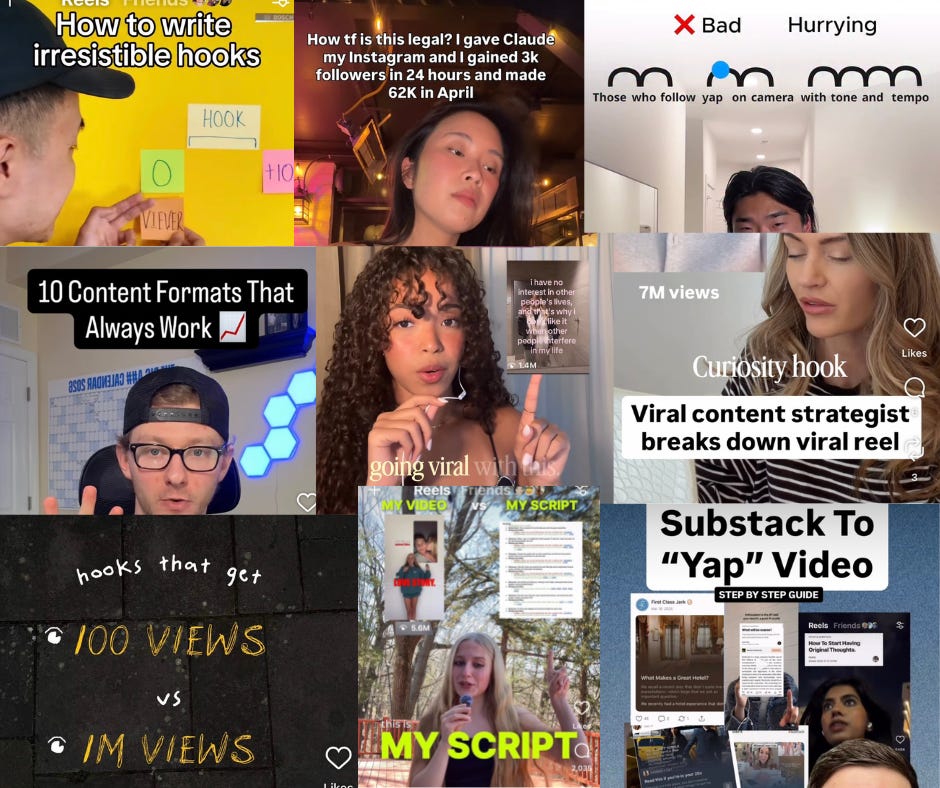
It is a brutally competitive environment, and like every brutally competitive environment, the science of how to win has been meticulously studied. Across TikTok and Instagram, an array of content strategists break down viral videos, pegging success to things such as: “Curiosity hook”, “series content so you follow and binge”, “movement keeps you engaged”, “unique fonts”, “personal story to build connection.” At no point is there a discussion of whether anything meaningful was said that was worthy of your attention, just that it was perfectly optimised to hold it.
Yet it is through such mechanisms that a teenager with a phone can command a larger audience than most publications I write for, or a reel titled “5 Things You Didn’t Know About Bananas” can be watched by more people than a TV programme with a $20 million budget. It’s also why authors are told to think about popular BookTok tropes, the chairman of Berklee College of Music’s Songwriting Department tells students to make “super catchy, really fast” algorithm cat-nip music, and why one of Hollywood’s most media-averse movie stars, Leonardo DiCaprio, is now doing TikTok trends to promote his films.
We are all trying to learn how to play the game, but the rules of the game are increasingly determining what gets made - and in our desire to win, we are losing sight of what makes something even worth paying attention to in the first place.
It’s taken me a long time to write this, and I feel a little guilty that as a result I haven’t uploaded anything in over a month. Every week that goes by I tell myself that I should just stick with a format that can be finished in a day or two. It’s why I used to post ins/outs lists and share everything I’d been reading that week, even though they’re not the best reflection of my voice or outlook of the world. Part of me wonders whether I should just accept the logic of the system. Why spend all this time writing something that only a fraction of people will actually leave one app, open another one, to read in full? If my goal ultimately is to make people think about the world around them more deeply, shouldn’t I just surrender and make a short-form video, or get ChatGPT to knock out a shareable infographic? Actually, why bother doing anything at all, when a video of a cartoon strawberry getting fucked by a cartoon banana is going to absolutely annihlate me on engagement anyway?
Attention, like any currency, is an exchange. What we invest our attention in today shapes the foundation of the thoughts and ideas we draw from tomorrow. Unlike money, though, it leaves no monthly statement - making it easy to spend without noticing. In the US alone, economist David S. Evans estimated the attention economy to be worth $7.1 trillion and 437 billion hours in 2016. Has the return we’ve received come anywhere close to this?
At its best, paying attention is a doorway into another person’s consciousness, allowing us to inhabit experiences beyond our own. It’s a form of capital investment, one whose dividends compound as you carry those insights forward. At its worst, paying attention is an extractive economy: a system that takes and takes and offers nothing in exchange but a blur of content designed to be forgotten as soon as it is consumed, so that way, you’ll always remain hungry for more.
Why do some stories last forever while most content is forgotten instantaneously?
Almost ninety years before social media industrialised the attention economy, Walter Benjamin foretold the cultural conditions that would eventually make it possible. In his seminal 1936 essay The Storyteller he examined what happened when the advent of newspapers made more information available than ever before. For the first time in history, you could learn about wars, scandals, disasters, divorce, political upheavals one day, then theatre reviews, racing scores, gossip, murders the next, ad infinitum. You might not necessarily understand what any of it meant in the grand scheme of things or how it applies to your life, but you could be non-stop entertained by stimulating, glorious information.
Information’s value often comes from being new, which makes it inherently disposable because there is always something newer to know. For Benjamin, this constant turnover stood in direct opposition to storytelling, which operated on an entirely different timeline and served an entirely different purpose. He captures the distinction through two German words: Erlebnis and Erfahrung. Erlebnis refers to experiences as they unfold. Erfahrung, by contrast, is the understanding gained by actually sitting with those experiences and weaving them into your understanding of the world. Storytelling, according to Benjamin, comes from the latter. The storyteller’s role isn’t reporting on what happened, but to take the raw material of life and transform it into something that can offer others counsel - and no, that does not include advice on what creatine is the ultimate It girl supplement (also available through their ShopMy).
In 1986, if you added up everything the average person encountered across television, radio, and print, it amounted to roughly forty newspapers’'‘worth of information every day. By 2007, according to researcher Sune Lehmann, that figure had risen to the equivalent of 174 newspapers a day. That was before Instagram, TikTok, YouTube, and Twitch, so it’s not even possible to count the number now. Much of what fills such feeds is raw information designed to satisfy an algorithm that demands daily offerings. It’s why you’ll likely never read the book that will genuinely change your life, but you’ll watch a 90 second “five key takeaways” summary. Or why, instead of writing a lengthy text about how our online performances of status are changing and questioning why we seek status at all, I’ll reduce it to: “status through clothing is out” while “status through knowledge is in” (and will most likely do something similar again). No wonder we can’t remember 90% of the shit we see or post.
Benjamin argued that the fairy tale and the epic were among the oldest and most enduring forms of storytelling, preserving and transmitting human experience across generations. Case in point: the Odyssey is currently one of the biggest films in the world, even though it was written over three thousands years ago. I haven’t read Homer’s version, yet the myths of the Trojan Horse and Achilles; heel are seared into my mind, no matter how much slop I layer over them.
We might assume these stories survived because they cracked the ancient equivalent of a good hook. When we hear stories about gods walking the earth or heroes descending into the underworld our instinct is often to dismiss them as primitive attempts to explain a world we now understand scientifically - the entertainment of a pre-TikTok world, dreamt up by people with nothing more stimulating to occupy their time. In A Short History of Myth, Karen Armstrong argues we’ve completely misunderstood their purpose.
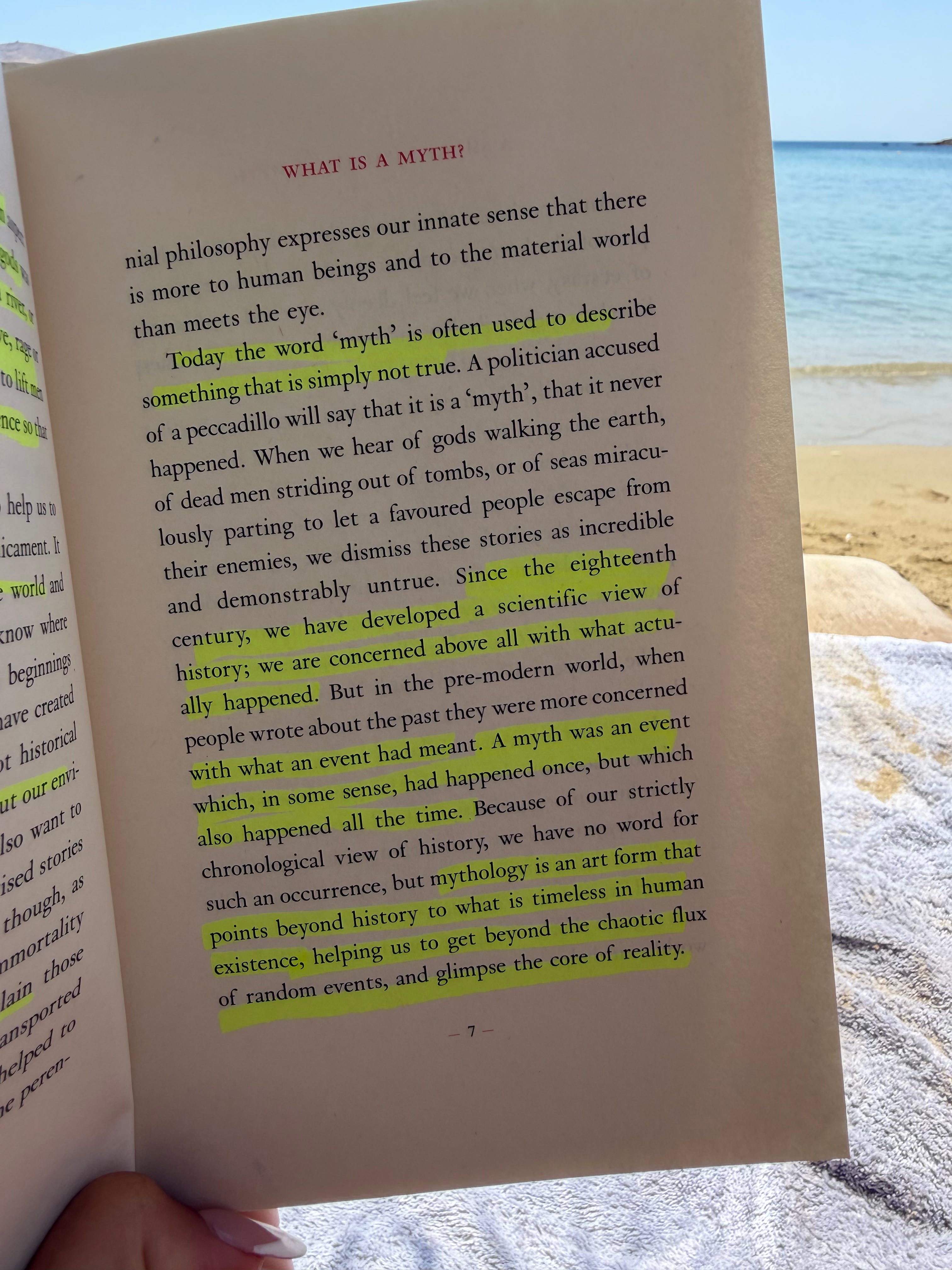
“A myth was an event which, in some sense, had happened once, but which also happened all the time,” she writes, adding they were never meant to record events exactly as they happened, but to reveal what they meant. “Mythology is an art form that points beyond history to what is timeless in human existence, helping us to get beyond the chaotic flux of random events, and glimpse the core of reality.”
Mythology, according to Armstrong, was one of the first forms of psychology - it is worth noting that both Carl Jung and Freud studied myths while developing their respective theses - because it gave people frameworks (or, as Walter Benjamin would say, counsel) for understanding messy human emotions like fear, desire, loss and ambition. Rather than info-dumping scandalous details, mythology took universal human experiences and turned them into patterns we can recognise, with lessons we can apply to our own lives. They endure because they capture emotional truths that remain relevant long after we finish the story, and in the process, subconsciously become a part of the way we understand ourselves.
For instance, the most enduring mythic archetype, arguably, is the hero’s journey. From Odysseus and Heracles to Shrek and Elle Woods, the journey begins with a sense that something is missing in the hero’s life. They are then pushed beyond the boundaries of what they know into monster-filled labyrinths or Harvard Law School, where each challenge forces them to shed an old version of themselves, so they can emerge transformed and return with the new knowledge they set out to find. We keep telling this story because, sooner or later, life demands the same transformation from us.
That’s all well and good, I hear you cry, but myths cannot cure diseases, split the atom, land humans on the moon, or connect billions of people through glowing rectangles in their hands - for that, we need another mode of thought, what the ancient Greeks called logos. It’s the mode of thought that gave us mathematics, medicine, engineering, law, economics, and is rooted in the belief that the world can be understood and eventually controlled - provided you ask the right questions and test the answers rigorously enough. Throughout history the two have existed together as complementary ways of understanding the world. One helped us build ships that crossed oceans and machines that could bend the world to our will; the other reminded us that every act of mastery carries the temptation of hubris - and warnings of what can happen if we give into it.
That was until the sixteenth century, when the Enlightenment took hold and rational inquiry became the dominant way of making sense of reality. Thinkers of the period argued that humanity’s suffering was not an unavoidable feature of existence as myths suggest, but a problem that could be solved by the accumulation of knowledge through the application of reason. In The Advancement of Learning, Francis Bacon went as far as to proclaim that scientific thinking would liberate humanity from ignorance and provide the means to remake the world. Religious myths and inherited traditions, once treated as sources of wisdom and moral guidance, were increasingly subjected to rigorous criticism; any belief that could not withstand empirical scrutiny was to be discarded.
Rationality has given humanity unprecedented power, but it hasn’t been able to answer the deeper question of what that power should be used for. It has allowed us to engineer feats once thought impossible, like the construction of the Titanic, which was once heralded as a triumph of human innovation - only for the “unsinkable” ship to sink on its maiden voyage. Didn’t they warn of such hubris in the story of Icarus… It has also allowed us to harness the energy contained within the atom, only for that same scientific breakthrough to culminate in the weapons dropped on Hiroshima and Nagasaki. Wait, isn’t that just the age-old Promethean lesson that we keep inventing new things without the discernment to use them responsibly…
Today, technology can explain how attention works, but it cannot tell us what actually deserves our attention. The algorithm operates almost in reverse to myth by triggering our oldest instincts but offering little means to understand them. It turns curiosity into clickbait, anger into ragebait, desire into aspiration, and loneliness into engagement - all while training humans to turn their experiences into information-heavy content designed to be consumed once. We have built softwares capable of measuring every second of our attention, yet forgotten the older question that mythology spent thousands of years trying to answer: what kind of stories are worthy of our attention, and subsequently, worthy of shaping us?
Attention is the most valuable scarce resource because it determines what we become.
Currently the winner of the attention economy is Mr Beast. He has over 484 million subscribers, making him the biggest channel on the second biggest website in the world, where each of his videos regularly exceeds 100 million views. In a leaked internal memo titled How to Succeed in MrBeast Production, a 36-page document explaining his philosophy of content creation, he describes exactly how he achieved this dominance:
“I spent basically 5 years of my life locked in a room studying virality on Youtube. Some days me and some other nerds would spend 20 hours straight studying the most minor thing: like is there a correlation between better lighting at the start of the video and less viewer drop off (there is, have good lighting at the start of the video haha) or other tiny things like that. And the result of those probably 20,000 to 30,000 hours of studying is I’d say I have a good grasp on what makes Youtube videos do well.”
His decision-making process boils down to things like: “I Spent 50 Hours in My Front Yard” is a weak idea, because nobody would click on it. “I Spent 50 Hours in Ketchup” is better, because “an image of someone sitting in ketchup in a bathtub is exponentially more interesting.” In a film, the ketchup would be a stylistic choice derived from a director’s decade-honed point of view, or a symbol meant to represent something larger - like Warholian consumerism, say. Here its only purpose is to be strange enough that your thumb pauses for half a second before it keeps scrolling. It is a very lucrative purpose. His estimated annual earnings from YouTube alone are around $100 million. His net worth is estimated at $2.6 billion.
As much as we think we have abandoned mythical thinking, MrBeast occupies an almost mythological role in the attention economy. To millions, he represents the ultimate hero of the system because he entered the algorithmic wilderness and mastered its rules completely. Hence his cult following that treats him with a level of devotion befitting a modern-day messiah. Yet the hero myth was never about making idols to worship, but about activating the heroic potential within ourselves.
In the memo, MrBeast also states that YouTube is the future, and that “99% of movies or TV shows would flop on YouTube.” Ironically, some of the most interesting filmmakers of the next generation have succeeded by doing the opposite of what he recommends.
In 2019, an eerie image of an endless yellow office spawned an internet urban legend known as The Backrooms, becoming one of the web’s most infamous liminal spaces. These spaces range from deserted school corridors to anonymous hotel hallways - basically, any environments that feel uncannily familiar yet deeply unsettling, like they have “shedded their skin and they’re wearing a costume of the past,” says Kane Parsons, who recently transformed the internet-born myth into an eponymous box office smash.
At just fourteen-years-old he taught himself Blender to transform the lore into a 23-episode horror web series, which at no point, felt engineered for maximum retention, lingering instead on empty corridors and glitching with old VHS aesthetics. He is now the youngest feature-length director in A24 history at twenty years old, so far making $390 million on a $10 million production budget. In interviews, Parsons has never once spoken about how he maximised the IP’s commerciality, stressing instead his responsibility to the dedicated community who convene on Reddit to discuss every painstaking detail that makes the world feel so real, like which fluorescent light bulbs they think The Backrooms uses.
Although Parsons is not the subject of the film, I feel I understand more about what he’s genuinely into and his values by spending time inside in the world he created, than I do from many influencers who post six times a day. I’m not suggesting everyone should do exactly what he did. The lesson isn’t to make analogue horror on YouTube any more than the lesson of The Odyssey is to sail into the Mediterranean for ten years. It’s the conviction to venture into the unknown without any guarantee of what will happen next.
“All art is autobiographical; the pearl is the oyster’s autobiography,” the Italian filmmaker Federico Fellini once said. Today, we often equate autobiography with subject matter because if large language models can generate ideas and write scripts, and tools like Midjourney can generate images and videos, it can seem as though the only way left to make something personal is to talk about yourself. To me, the more interesting autobiographical element is the beliefs embedded in the process that made the work, and what the creator was willing to risk even though the odds felt totally stacked against them. Just how the pearl might not look like the oyster, but it could only have been created through a process unique to that oyster.
One of my favourite Substacks is Girl Insides, an anonymous blog that isn’t promoted anywhere except through its own page. Every instinct of the attention economy would tell you this is a terrible strategy, but I could genuinely see her ending up in the I Love LA writers’ room, or turning her brilliant entries into a book and/or TV series. Another favourite of mine is Biz Sherbert’s American Style. I’ve always respected that Biz has built something entirely on her own terms, outside the way mainstream media usually likes to talk about things, and earlier this year she partnered with American Vogue on a mammoth project that was unmistakably hers in both vision and execution. I can’t wait to see what she does next.
I am not proposing that we exit the attention economy - it would be naive to suggest that we can, but we should become far more discerning about what we pay attention to. The future storytellers of this economy shouldn’t just be those who figured out how make people stop scrolling, but those who create something that survives after the scrolling stops. Something people continue thinking about long after they put down their phones, because it influences how they see themselves and the world, not simply what they buy.
That is the myth the attention economy needs most - not the fantasy that anyone can go viral, but the conviction to make something in the way only you could make it, without letting the pursuit of optimisation become the purpose itself. Then, like every hero before, to venture into the unknown and see who you become in the process.

“The future storytellers of this economy shouldn’t just be those who figured out how make people stop scrolling, but those who create something that survives after the scrolling stops. Something people continue thinking about long after they put down their phones, because it influences how they see themselves and the world, not simply what they buy.” YESSSSS
to read this was an Erfahrung!